Dresden
In Dresden, I visited the daughter of my mother’s old friend Guenter Reimann, author of The Vampire Economy: Doing Business Under Fascism, a seminal study known to many classical libertarians. Karen showed me around and told me how the German economy strangled entrepreneurs. She had various stories of East Germans being prohibited from or put out of (small) business because they could not afford the taxes, regulations, labor laws, etc. West Germany’s reunification will go down in history as one of the clumsiest, most expensive wastes in history; it mostly preferred to put East Germans on welfare rather than let them compete (at lower wages) against West Germans.
Karen also reminded me of Kurt Vonnegut’s book, Slaughterhouse-Five, the story of an American POW who survives the bombing of Dresden and sees the ruins. Some six weeks before Germany surrendered, British and American bombers set World War II’s second firestorm, on one of the most beautiful cities of Europe, which had little industry but many women and children fleeing the advancing Russian army. First, the Allies used explosives to lay bare the attics and upper floors, then they followed with incendiary bombs to set the fires. No one knows how many died; some figures are as high as 200,000. Originally, I had learned that the Soviets asked us to bomb it. Others point to Arthur "Bomber" Harris, of the British Bomber Command. Interestingly, Harris got his start gassing Kurds and Arabs who were rebelling against British rule in Iraq.
Budapest
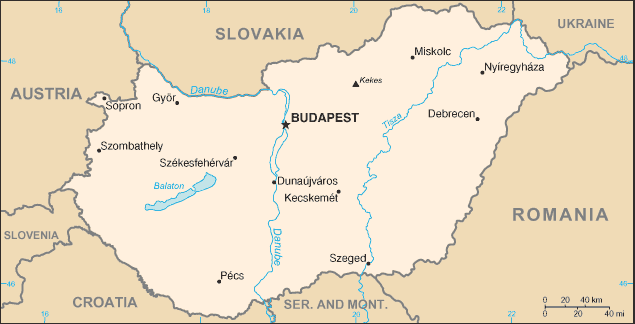
Budapest is also a most beautiful city. My old friend Count Laszlo Karolyi showed me where the Russian and German armies had flattened both sides of the river in the middle of town. He had seen it as a child. Today there is a two-year-old Terror Museum about the Soviet secret police and occupation. It has a black T-54 tank in the courtyard, and is very well done, with videos, artifacts, and explanations. (There are few museums about communism, but another is the Perm concentration camp in the Ural Mountains, which I visited last year.)
Karolyi, from one of Hungary’s oldest families, told me how the smaller nations of Eastern Europe love America and see it as their bulwark for continued freedom and prosperity. Most citizens, he argued, opposed Bush and his war because they saw it as severely weakening America. They fear that a weakened America will become isolationist and abandon Europe.
Tbilisi
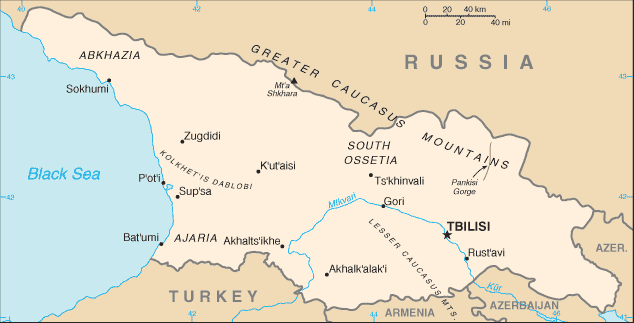
Tbilisi is the capital of Georgia, in the heart of the Caucasus Mountains. I went with a study group from the Jamestown Foundation. President Bush recently visited Tbilisi and was welcomed very warmly. The country is mainly agricultural, on the Black Sea, where Jason and Pegasus searched for the Golden Fleece in ancient times. It and neighboring Armenia are Christian bastions in a sea of Muslims.
Astounding economic reforms are taking place in Georgia. The new government passed legislation to eliminate nearly 800 regulations concerning licenses and permits for business. Public safety and foreign treaty laws, however, remain in place. Registration to start a new business can now be done in one day for individuals or three days for companies. Ministries must give an answer to public requests within 30 days, otherwise the request is automatically approved. Courts must render decisions within 30 days of the close of trials. All these measures are extraordinary for anyone who follows Third World economics (read Hernando de Soto) and indicate how microeconomic free-market thinking is now spreading in the world.
The nation had been afflicted with tremendous corruption and civil strife after the collapse of communist rule. Bribes were demanded by the police and other officials for most government functions. The new government has raised monthly police salaries from $30 to $200, while cutting the police forces by nearly two-thirds. Less corruption allows for lower taxes and provides money for more efficient government.
I was interviewed on local TV and said that Georgia was setting a new path for Russia and Ukraine, that their example could change the whole region. The young Georgians who put through the law were a bit nervous, but solid in their learning and convictions from the great libertarian think tanks in America.
Paata Sheshelidze and Gia Gandieri of Georgia’s New Economic School (an Atlas Templeton Prize winner for student programs) explained to me how they arrange seminars for students and are developing a program to bring in young Iranians and Iraqis as well. They lecture on the economic reforms that have brought prosperity to other nations. The staff has been so effective and recognized that nearby Kyrgyzstan’s new "tulip" government invited them to lecture and explain how the Georgian government was able to institute basic reforms. The Soros Foundation funded the trip.
Our delegation was also flown by helicopter to the frontier with Chechnya to a partly Muslim area, the Pankisi Gorge, where the Russians had threatened to invade to eliminate Muslim fundamentalists whom it accused of funding the Chechens. Today they are gone, but a new, large mosque, funded by the Saudis, is symbolic. We were at the foot of the snow-capped Caucasus Mountains, which looked impenetrable, with only a few passes, now controlled apparently tightly. Yet the story was that passage through Russian lines used to cost a bribe of merely 10 rubles, some 30 cents, and this facilitated outside contacts with the Chechens. The Georgians now receive American aid, and the Huey helicopter that flew us had a very sharp, American-uniformed and -trained crew.
Baku
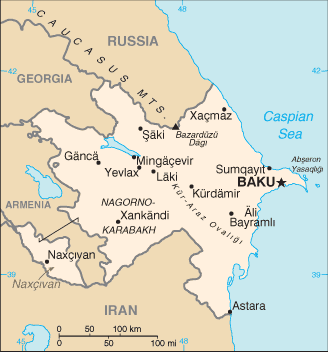
Our next stop was Baku, capital of Azerbaijan, on the Caspian Ocean. They are celebrating a new million-barrel-a-day capacity pipeline (Baku-Tbilisi-Ceyhan), now being filled, to the Mediterranean coast of Turkey. The nation has some of the oldest oil fields in the world, and the town used to be a wide-open port city with a wide mix of nationalities and cultures. War with neighboring Armenia ended with a hundred thousand Armenians expelled from the city, with many killed. This came about when Armenia occupied a part of Azerbaijan, Nagorno-Karabakh, and expelled the Azeris. Our delegation was also flown to the front lines by helicopter to see a still-tense situation with occasional shootings and deaths. The Armenians have better-trained troops and officers and get support from the Russians (as well as the diaspora in America). However, their younger citizens are emigrating abroad, seeing little future in the landlocked nation. Armenians also are divided between the highlanders, peasants, and fighters, who deprecate the traders and businessmen, who would rather negotiate peace.
Congress prohibited the U.S. government from training or aiding Azerbaijan. However, after 9/11 President Bush suspended the law, originally inspired by the Armenian lobby, in the name of the national interest. Azerbaijan is helping the U.S. in the War on Terror, and its landing fields are a major way station for air transport from the U.S. to Afghanistan. U.S. embassy officials told us that they were very satisfied with Azeri cooperation, although it was not publicized.
Azerbaijan is ruled by the son of its former dictator, Ilham Aliyev. We had an extensive interview with him. I asked about the reforms in neighboring Georgia, and he answered that his government was also conscious of such problems and that it too had spread up the permit process for businesses. Most former CIS nations (and Latin America and Africa) are overburdened or even throttled with petty corruption stemming from government permits and inspections of business. These have made business startups and new employment very difficult, yet are extremely hard to reform, because they stem from the bureaucracies’ own vested interests in their survival (witness Putin’s Russia).
Azerbaijan is a relatively free nation with upcoming parliamentary elections this fall. These may reveal more anti-government sentiment than is apparent now. The president’s powers are circumscribed by infighting, and the government allows the International Republican Institute to conduct democracy training and support publications. Azerbaijan is a real country with a diversified economy and well-developed agriculture, not like most desert oil mini-states. There is still tribalism and some of the other afflictions of the Middle East, but without the religious fundamentalism. Washington fears the election, yet also wants it to give legitimacy to the U.S. presence.
All the Caucasus nations have millions of their citizens working in Russia, sending home savings and reinforcing a significant cultural affinity. Consequently, while they want American protection for their newfound independence, they don’t want to antagonize Russia. Azerbaijan, with a population of some 8 million, has now quintupled its trade with Russia, mainly in agricultural goods. Its new oil riches could fund a large boom, if the money gets out to the people. This is more likely than with the Arab nations, as Azerbaijan is much more modern. One hardly sees a single head scarf in the downtown streets, certainly not upon the young, and the nation is very secular as a result of its communist past. However, tens of thousands have started going to mosques, and there is a small, but increasing, growth of fundamentalism. It all has to do with finding their identity, and the government is certainly sensitive to the perceived conflict between Muslims and America.
The Azeri major who escorted us to the front lines with Armenia explained how his units were getting some U.S. (and Turkish) training. He said both were very good compared to Russian military training he knew of, which was 30 years old and partly obsolete.
What one does see is progress and gradual Westernization in a positive sense. The Caucasus nations are evolving in a positive way. Competent and honest government is still a ways off, but there is growing recognition of what economic conditions are necessary for freedom and economic prosperity. Also, they have the advantage that the communists provided solid basic education and suppressed tribalism for nearly a century. Consequently, they have the possibility of becoming modern nations.